Two Divine Images
On Blake, Vaughan Williams, and Our Fractured Moment
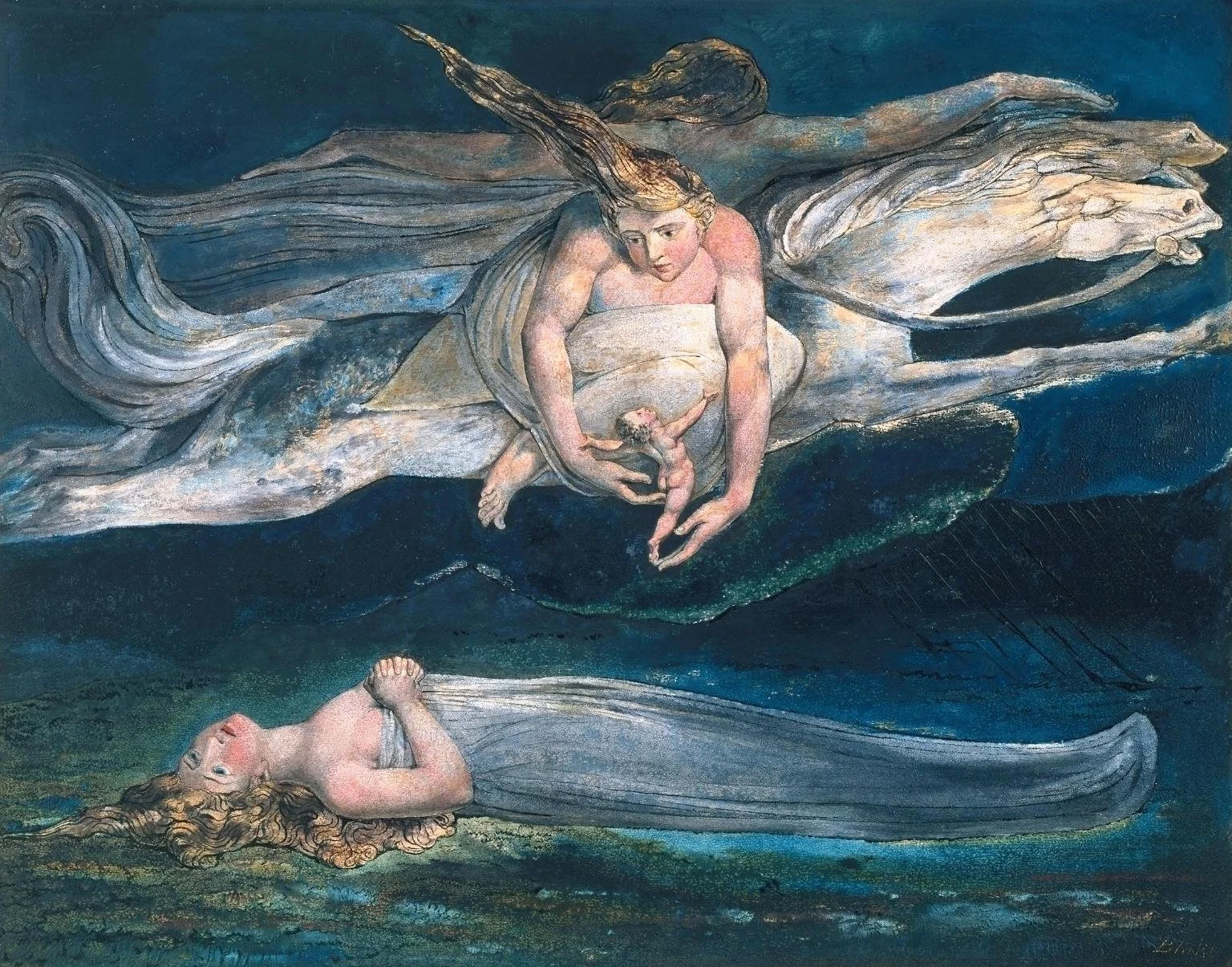
Pity by William Blake (1795)
Last month, while preparing for a performance of Vaughan Williams' Blake Songs with the Philadelphia Chamber Music Society, I found myself returning again and again to two poems set back-to-back in the cycle: "A Divine Image" and "The Divine Image." In the score, they face each other on opposite pages like mirror images. While federal agents were shooting civilians in the streets of Minneapolis, I was learning to sing Blake's words about the dual nature of humanity—our capacity for both unspeakable cruelty and transcendent compassion.
The juxtaposition felt almost unbearably apt.
During the last administration, President Joe Biden was justly criticized for repeatedly saying in the face of atrocities committed by US citizens, "this is not who we are." To be frank, saying such a thing about America is delusional. A cursory scratch below the surface of the history we are taught, and it becomes abundantly clear that this is exactly who we are—just as much as we are the people who marched and protested non-violently to win the war for civil rights. While it may seem esoteric to tie eighteenth-century poetry and twentieth-century art song to the horror of our current moment and the unceasingly awful news cycle, Blake's vision continues to haunt me. Perhaps because it refuses the comfort of easy answers.
In "A Divine Image," Blake describes the abject cruelty of humanity, our capacity for truly dark evil:
Cruelty has a human heart,
And Jealousy a human face;
Terror the human form divine,
And Secrecy the human dress.
Our shadow is composed of jealousy, terror, and secrecy—an unquenchable fire. Reading this poem today, it's not difficult to see the parallels in recent events: the federal government's separation of migrant children from their families, the acts of violence carried out by federal agents in Minneapolis and other cities, the ongoing efforts to obfuscate truth and sow doubt about democratic processes.
But in "The Divine Image"—a difference in title of only a simple article—Blake describes the heroic feats humanity is capable of, born out of mercy, compassion, and love:
For Mercy has a human heart,
Pity a human face,
And Love, the human form divine,
And Peace, the human dress.
Reading that poem, it is easy to see the heroic people organizing across the country to protect our immigrant neighbors, to see ordinary citizens asking if their fellow protesters are okay before being pushed down and shot, to witness the many people caring for our unhoused populations.
In both poems, the source of these qualities is the human heart. In both poems, the power to produce any of these qualities is infinite.
Listening to and reading analysis of the past six to eight years’ cultural and political turmoil, the conflict is so commonly framed as a battle to save democracy. But it seems to me like something deeper: a battle for the soul of humanity. Consumed by terror, shame, anger, and greed, our more compassionate, caring, and conscientious selves are suffocating for air. In a time in which profit is prioritized over welfare, it becomes challenging to commit to serving something larger than the self. In an age of cynicism and nihilism, it becomes increasingly difficult to nurture hope in our hearts and hold out a vision for our future that can inspire.
As technology makes information increasingly accessible and the world shrinks through interconnectedness, it feels as though humanity cannot grapple with its shadow.
On one side of our imaginary binary, the right seems unwilling and unable to reckon with the faults of human history. On the other side, the left seems unable to let go of the anger that has flared up as a result of that reckoning. In the imaginary center, people seem paralyzed, grieving the loss of a status quo that was never sustainable in the first place.
As the news cycle continues to accelerate toward warp speed, what is up is down as both sides continue to switch positions in what feels like a disorienting dance as we descend toward chaos.
Those who adamantly opposed gerrymandering now demand it. Those who previously wanted to rig the electoral maps in favor of a specific party now oppose the efforts of the other side to do the same thing, taking them to the Supreme Court.
Second Amendment activists who praised Kyle Rittenhouse as a hero now argue it shouldn’t be allowed to take a gun into a protest. Gun abolitionists are now fighting for the right to carry arms.
The people who once dismissed conspiracy theories about cabals of rich and powerful pedophiles as paranoid delusion are now demanding more transparency around the Epstein files, because it turns out that those theories may not have been so outlandish. Those who were once taking guns into pizza parlors to free supposed victims of human trafficking are now strangely silent as information about Epstein and his cohort comes to light.
These opposing forces don’t just exist in opposition to each other. They’re now locked in a perverse waltz of constant switching, the incessant spinning leaving us all with a sense of vertigo.
Ralph Vaughan Williams: Cruelty Has a Human Heart from Ten Blake Songs performed with James Austin Smith, oboe, in San Francisco in 2018
These poems first came to mind during the pandemic lockdown, as we all reckoned with the murders of George Floyd and Breonna Taylor, and what those horrific incidents revealed about the nature of America. At the time, I looked to Vaughan Williams’ songs as a beacon of hope—a ray of light showing that it is possible to appeal to our better angels, as long as we learn to accept our shadows.
But in such a bewildering moment, where the fractures that divide us seem increasingly impossible to heal, it makes me wonder: what does our “better angel” look like? As the chaos whips up more and more toward a maelstrom, and conflict seems almost inescapable, which angel do we appeal to? And which one is actually the better one?
Blake gives us no easy answer. He simply places the two poems face to face, mirror images of the same truth. Both are human. Both are real. Both are divine.
Perhaps the task before us is not to choose which image represents the “real” America, or the “real” humanity, but to hold both in our gaze simultaneously. To acknowledge our capacity for both cruelty and mercy, both terror and peace. To recognize that the same heart that can perpetrate violence can also extend compassion—sometimes within the same person, the same nation, the same moment in history.
This is uncomfortable work. It offers no neat resolution, no heroic narrative where the good guys win and ride off into the sunset. It asks us instead to sit with paradox, to resist the urge to flatten complexity into binary thinking.
And yet, sitting with that tension feels more honest than pretending we are only one thing or the other.
I still pray that love and compassion can win the day. But perhaps “winning” doesn’t mean the final eradication of our shadow. Perhaps it means learning to face both divine images at once—clear-eyed about our capacity for darkness, committed to choosing light, and humble enough to know that the struggle between the two is the most human thing about us.
That struggle is where Vaughan Williams’ music lives. In the space between those two facing pages. In the breath between terror and mercy. In the human heart.