The Master Is Always the Student
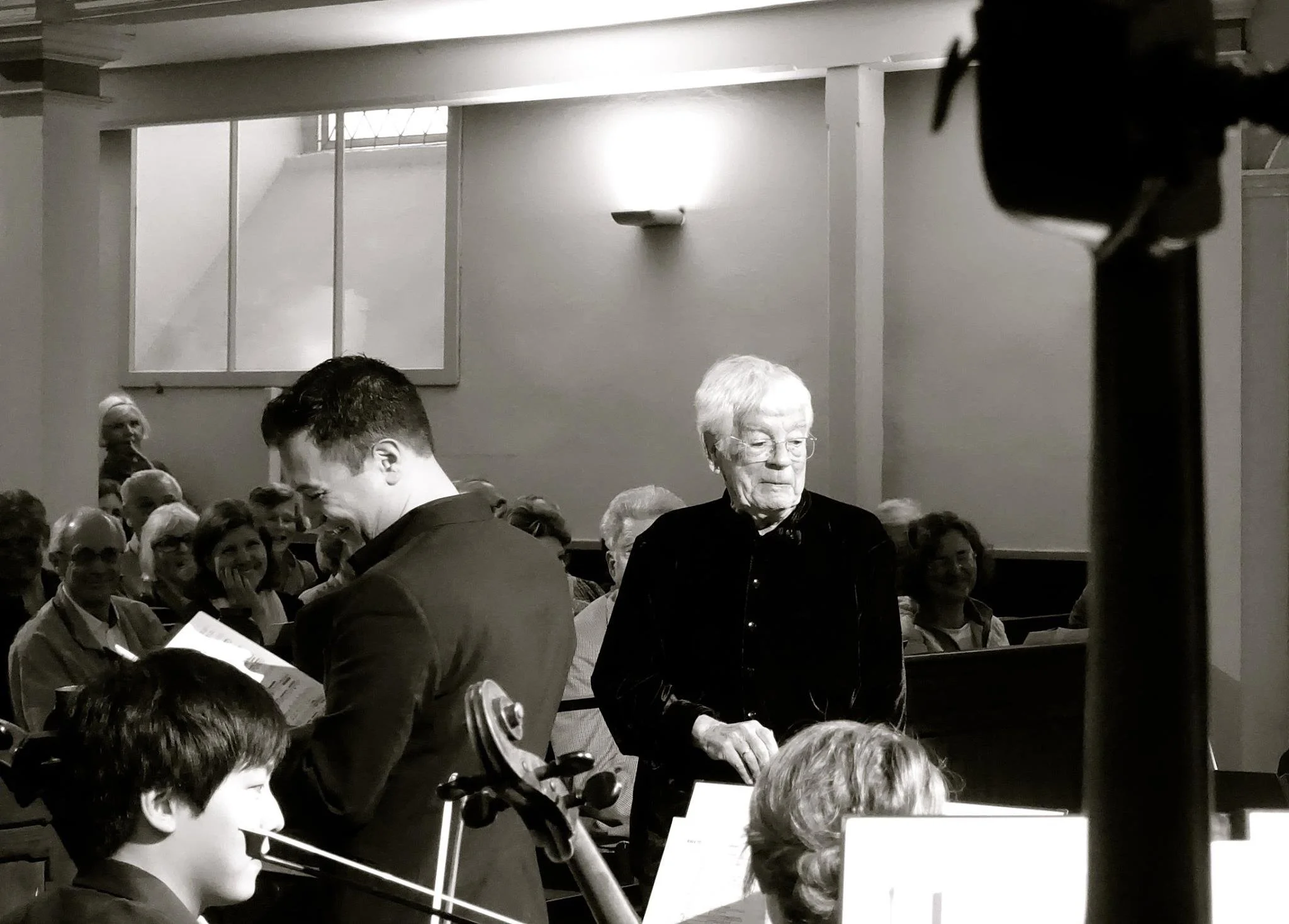
performing with Helmuth Rilling and the Weimarer Bachkantaten-Akademie at the Georgenkirche in Eisenach, Germany in 2017 (photo: Christoph Drescher)
The world lost one of our era’s greatest advocates for the music of Johann Sebastian Bach with the passing of Helmuth Rilling last week. I was saddened to learn of his death last Thursday morning, when a friend who knew that I had the honor of working extensively with Rilling over the years reached out with condolences. It was just two days shy of the 17th anniversary of our first meeting, at Carnegie Hall, on Valentine’s Day 2009.
I have been privileged to work with many inspiring conductors over the course of my musical life, and Helmuth stands out as a particularly formative mentor. Our meeting seemed ripped from the mythologies of musical fortune. My manager called me the morning of February 14th, inquiring where I was. I told her I was actually on my way to Carnegie Hall for a rehearsal with a conductor friend who was singing in the chorus at Carnegie later that night. We were going to begin preparing for an upcoming St. John Passion we had together in Boston the following month. She told me it was not looking as though the tenor soloist would be able to perform that evening due to illness, and asked if I had ever sung Haydn’s Creation before. I had…Once, in English, nearly a decade prior. She told me that if I were to jump in, the performance would be in German. I told her to have the hall leave a score at the stage door, and I would look at it. Instead of rehearsing Bach that afternoon, my friend and I crashed through the Haydn, and I determined that I could do it. Helmuth agreed to meet me and asked me to sing through the entire score in his dressing room. After reading through it together, cover to cover, he looked at me and said: I think you can do this. It was 4:30 p.m. The concert was at 7:30. I ran home to grab my concert clothes, came back to the hall, and walked onstage, meeting the members of the orchestra for the first time as the audience applauded during our entrance. Despite having no rehearsal with any of my colleagues and basically sight reading the work, the concert went beautifully. It was a defining moment that marked not only my Carnegie Hall debut, but the beginning of a decade-long musical relationship with Rilling that would prove deeply formative to me as a musician and as an artist.
Helmuth had a remarkable ability to gather extraordinary people around him, almost exclusively through his devotion to Bach’s music. He was surrounded not only by his close-knit family (all formidable musicians in their own right), but by colleagues of all ages, scholars, supporters, and friends from every corner of the musical world. To be part of this circle of Bach devotees was a breathtaking experience. Some of the friendships I formed during those years, touring as part of Helmuth’s cohort, remain among my most treasured musical friendships to this day. All of it flowed from his love for Bach’s music and from his belief in its power to make us better musicians, better artists, and better people. The discipline required to perform and truly engage with Bach was something Helmuth understood as a practice in service: learning how to place something greater than ourselves at the center of our work, and how to find confidence through humility and reverence. Through his encyclopedic knowledge of the music, he demonstrated that there is always more to learn, and he modeled what it means to maintain the grace of a beginner even as one deepens in mastery. I remember being amazed listening to his wife Martina talk about his decision, as late as 2017, to begin experimenting with period instrument ensembles — a striking evolution for someone who had been committed to modern instruments throughout his career, even as the historically-informed performance movement grew up around him. He remained a learner until the end. Despite being among the most eminent figures in the field, he embodied the ethos that the master is always the student.
a mini-documentary about Helmuth Rilling’s Weimarer Bachkataten-Akademie
Although I first met Helmuth through Haydn, I performed almost exclusively Bach with him throughout our time together. My BACH 52 project, which explores the question of Bach’s continued relevance to our society and culture today, was directly inspired by my time at Helmuth’s Weimarer Bachkantaten-Akademie, where a German journalist asked me: “Do you think the music of Bach is for everyone?” I cannot imagine that Helmuth would have ever questioned that premise. When we performed together, we were often surrounded by musicians ranging in age from their early twenties to their seventies, who had gathered from nearly 35 countries across four or five continents. He knew that Bach’s music was for everyone, and he understood, perhaps more deeply than almost anyone, how transformative music can be in a person’s life. We were all so fortunate to have been shaped by his commitment to this music, and to have been made better by knowing him.
Rest in peace, Maestro. And thank you for everything.
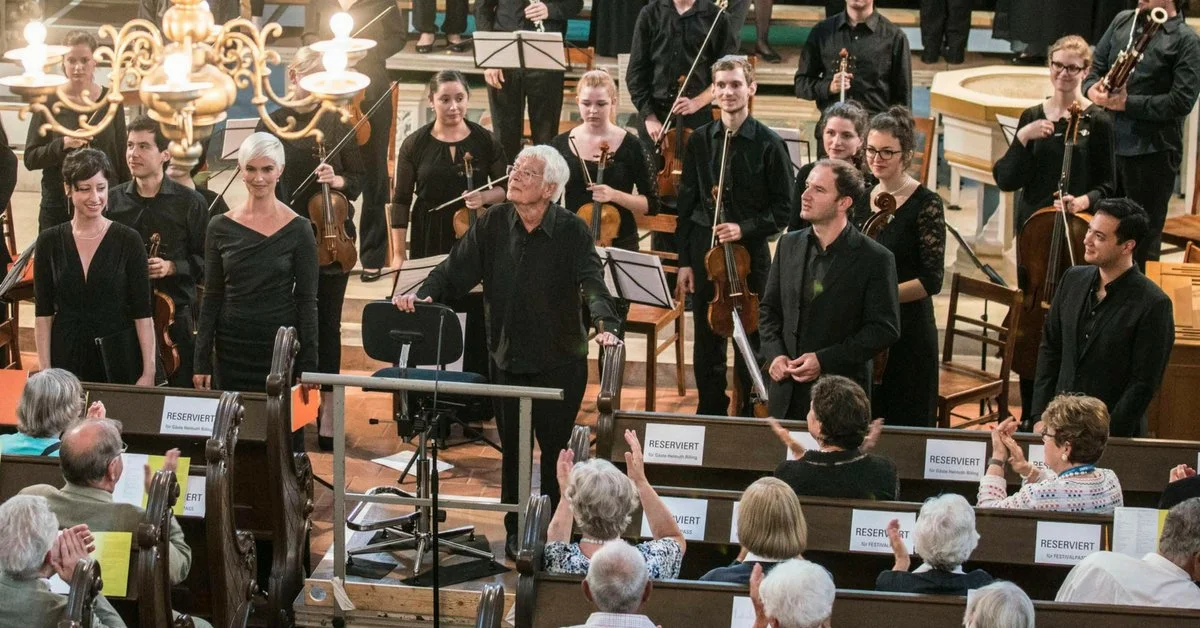
performing with Helmuth Rilling and the Weimarer Bachkantaten-Akademie at the Church of Saints Peter and Paul in Weimar, Germany in 2015 (photo: Marco Borggreve)