Outgunned, Outmanned, and other thoughts about Art Song Chicago’s Collaborative Works Festival
NOTE: I am now publishing these essays at my new Substack. If you wish to receive these in your inbox, please subscribe via the button below!
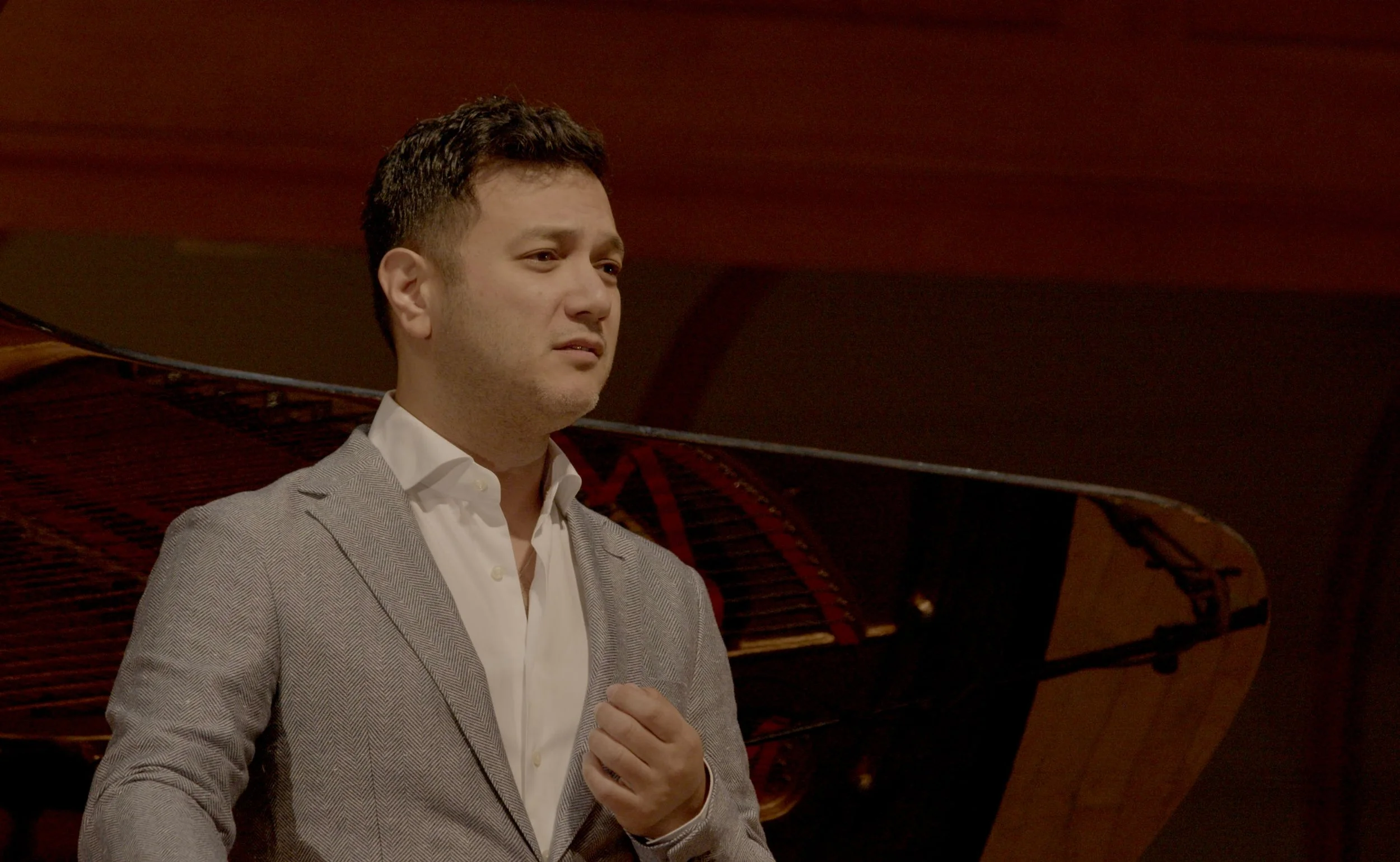
Performing at Art Song Chicago’s 2023 Collaborative Works Festival
Since 2013, I have had a tradition of beginning every concert season with Art Song Chicago’s annual Collaborative Works Festival, a series of concerts that explores any given theme through the medium of song. I often compare songs to little Pandora’s Boxes. Short in length and scored for the smallest of musical ensembles (often just a singer and one instrument), they seem small and innocuous on the surface, yet they contain multitudes within. Experiencing song, both as a listener and as a performer, is to live the experience William Blake conjures in the opening lines of his Auguries of Innocence: “to see a world in a grain of sand”. It is like looking through a kaleidoscope and seeing entire shifting universes through the small peephole of a child’s toy that you can hold in one hand.
As our news cycles and political discourse have intensified and consumed so much of our cultural brain space in the current digital age, it is inevitable that I have turned what I often refer to as the “lens of song” to the issues of the day. The luxurious opportunity to do that over the course of 3-4 days in Chicago each season has allowed multiple deep-dives into some of these issues, ranging from immigration and migration, to war and peace, to identity, to the influential history of Chicago itself. More than just concerts, these programs have become musical meditations on each of these subjects, seeking to look beyond the political, centering human emotion and experience in our consideration of each topic. I am profoundly grateful to the artists who pour themselves so generously into these recital performances, as well as Art Song Chicago’s devoted and thoughtful audiences, who turn out to share these moments with us season after season.
Performing the Midwest premiere of Viet Cuong’s Second Shore at Art Song Chicago’s 2025 Collaborative Works Festival with Lisa Kaplan, piano and Matthew Duvall, vibraphone
At last September’s festival, which meditated on songs of war and peace, one of the highlights was the opportunity to bring Viet Cuong’s Second Shore to Chicago for its Midwest premiere and second-ever performance. Viet composed the work as a musical narrative of his parents’ forced migration to the United States during the Vietnam War. Sitting a few weeks ago with my aunt in the town where my own family hails from in Greece, listening to our cousins recount the family histories of my grandparents’ own emigration stories to the US, I was reminded of Viet’s piece and the oceanic crossings triggered by history that made our lives possible as Americans. Both oral histories: my grandparents’ journeys narrated by my aunt and our cousins over midnight beers on the beach in Greece, Viet’s parents’ journey across the Pacific documented by their son in song. My grandfather sailed across the Atlantic Ocean on a ship from Patras, Greece that docked at Ellis Island in 1912 less than one month before the First Balkan War broke out. If the records are correct, he turned 14 years old somewhere in the middle of the Atlantic as he sailed away from his family. He later came back to Greece to marry my grandmother and sailed back to the US with her in 1947, when Greece was deep in the throes of civil war. Viet writes in his cycle: “Where does a boat go to not be forgotten? Wherever the sea commands. They long to scrub their hands of war with golden sands of a Second Shore.” They came to America from opposite ends of the earth, yet there are commonalities of their experience that are so beautifully encapsulated in song.
This year’s festival theme, Songs of the Earth, considers the challenges of climate change through a dialogue between poetry and music that spans centuries of literature and song. In doing so, it gives us…