HOROSCOPES, REHEARSAL ROOMS, AND SETTING DOWN SHIELDS
NOTE: I am now publishing these monthly newsletters here, mailing more comprehensive newsletters via MailChimp, and also publishing them at my new Substack. If you wish to receive these in your inbox, please subscribe via one of the buttons below!
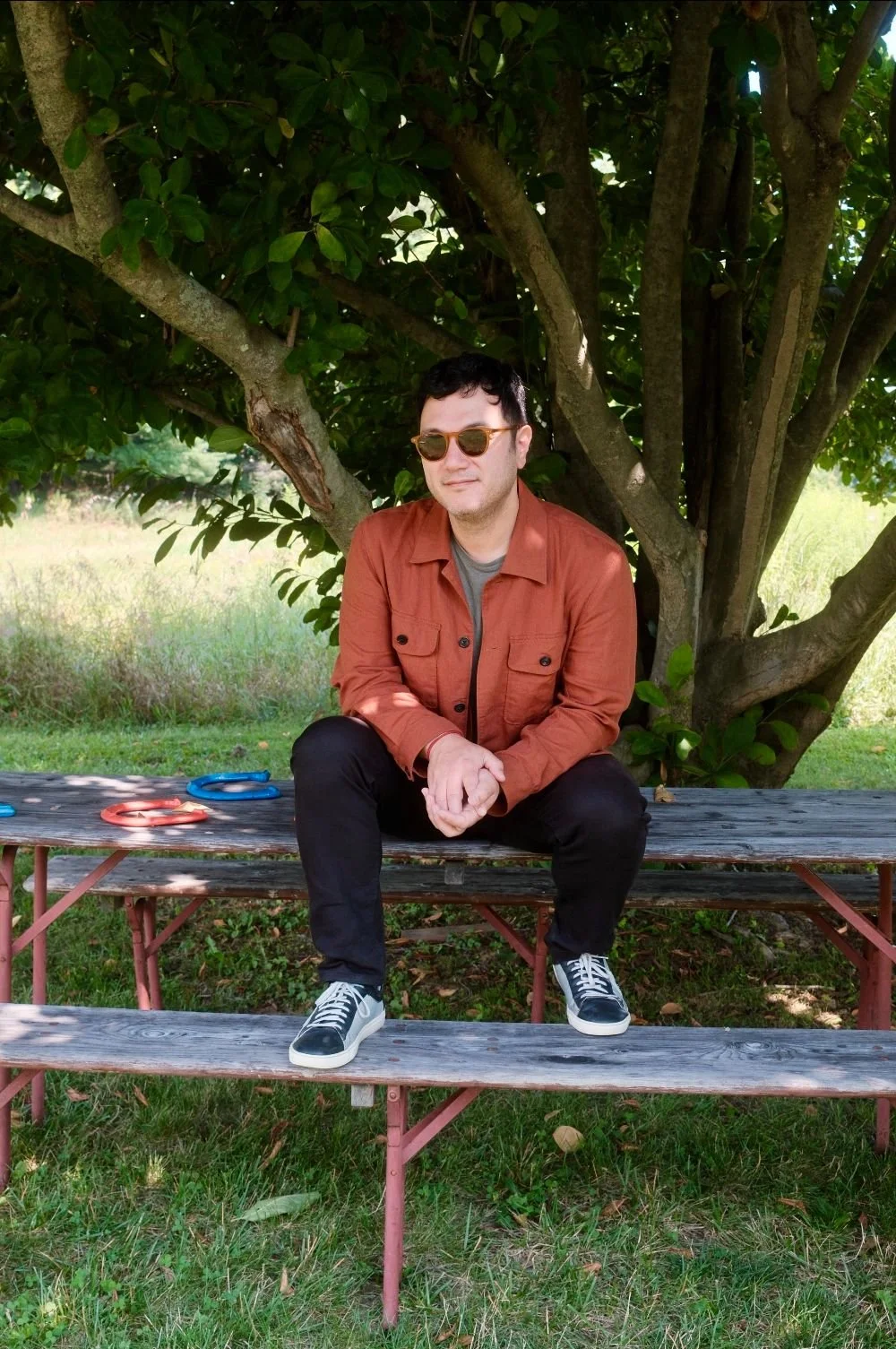
Near Tanglewood at the end of July
AN AUGUST 2026 Newsletter
They say that Mercury Retrograde, in addition to being a time of garbled miscommunication, is a time for slowing down and considering the patterns in one’s life. While I don’t usually put too much stock into astrology, I nonetheless find myself buying into horoscopes more than usual during these three-week junkets which tend to come around three or four times a year. Most of this past July was consumed with 2026’s second period of Mercury Retrograde, and, conveniently, my schedule was organically coming to a slower pace due to the simple fact that I was immersed in a staged opera project.
I don’t do staged operatic projects as frequently as I used to in the earlier years of my professional life, usually due to the complexity of blocking off enough time in the performance calendar to commit to one fully (they usually take weeks–at minimum–to produce). When I do find the right project, it always feels like such a luxury to root in one place for a bit and focus (mostly) on just one thing for a few weeks.
My horoscopes for this past month’s retrograde told me that it was going to be a time of revisiting past relationships, reexamining which ones fulfilled, which no longer served, and creating space for new ones to fill the spaces that might open up. Early into our process in Napa for the world premiere of The Judgement of Paris, I realized that one of these for me was my relationship with opera itself.
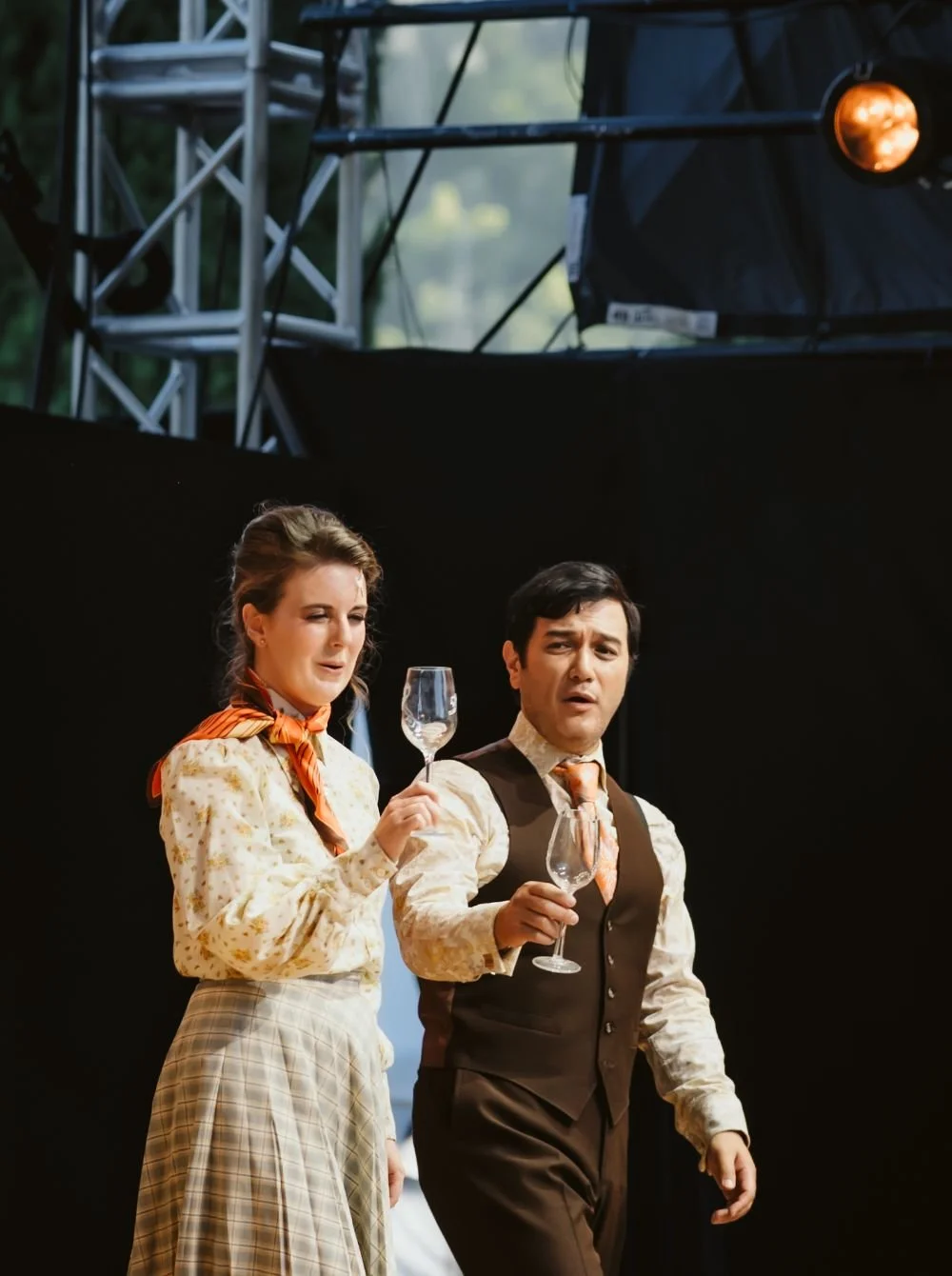
With Simone McIntosh in the World Premiere of Jake Heggie and Gene Scheer’s The Judgement of Paris at Festival Napa Valley
My adventure with opera has been a complex one, like most rewarding relationships that stand the test of time. At moments, it has been frustrating and painful, and at others it has been joyous and transformative. Sometimes, perhaps in some of the best moments, it has been all of those things at once, and more. Opera is, if nothing else, larger than life.
Early on in my days as a young artist, I found myself often cast in comic roles that had nothing to do with why I journeyed into a life in music in the first place. I fell in love with music as a young violinist playing Bach’s Brandenburg concerti and symphonies by Brahms. I discovered singing only via studying musical theater, where I became fascinated with the craft behind acting and the drama of plays we were performing at both my high school and at Interlochen Arts Camp, by playwrights like Arthur Miller and Lillian Hellman and composers like Richard Rodgers and Leonard Bernstein. I remember the first time I encountered the music of Rossini, it was accompanying a young mezzo-soprano in her performance of Una voce poco fa from the Barber of Seville from the second violin section of my youth orchestra. Not speaking any Italian nor understanding the plot of the opera, I was bewildered by Rossini’s seemingly simplistic music, wondering what the purpose of it was. Fast forward to my early years as a young operatic tenor, I would be cast as Rosina’s suitor, Count Almaviva in the Barber of Seville, or any other number of roles in other comic bel canto operas, where the purpose of the music–while genius in the cleverness of its construction–seemed (to me) to be mostly performing vocal pyrotechnics simply for the sake of showing off or to play to an audience for cheap laughs.
I eventually began eschewing the comic bel canto repertoire in an effort to be considered for more “serious” repertoire. It was during these years that my focus shifted heavily towards the song repertoire and concert work, where I could rejoin the composers who had been my first friends in the classical music repertoire–Bach, Handel, Mahler, Schubert, Beethoven, Brahms–as well as make new beloved composer friends, ranging from Monteverdi to Mozart to Muhly.
While so much of that decision to shift focus was borne out of choosing to follow my musical heart, the avoidance of the comic repertoire also had a heavy tinge of fear coloring it, as well, stemming from a deep-seated concern that people would not take me seriously as an artist. Combine that with a few overt messages I received during my formative years as a singer, like my Just Another Dumb Asian Singer story that I wrote about during the pandemic, and my insecurities took root in ways that sometimes have not served me in the best ways.
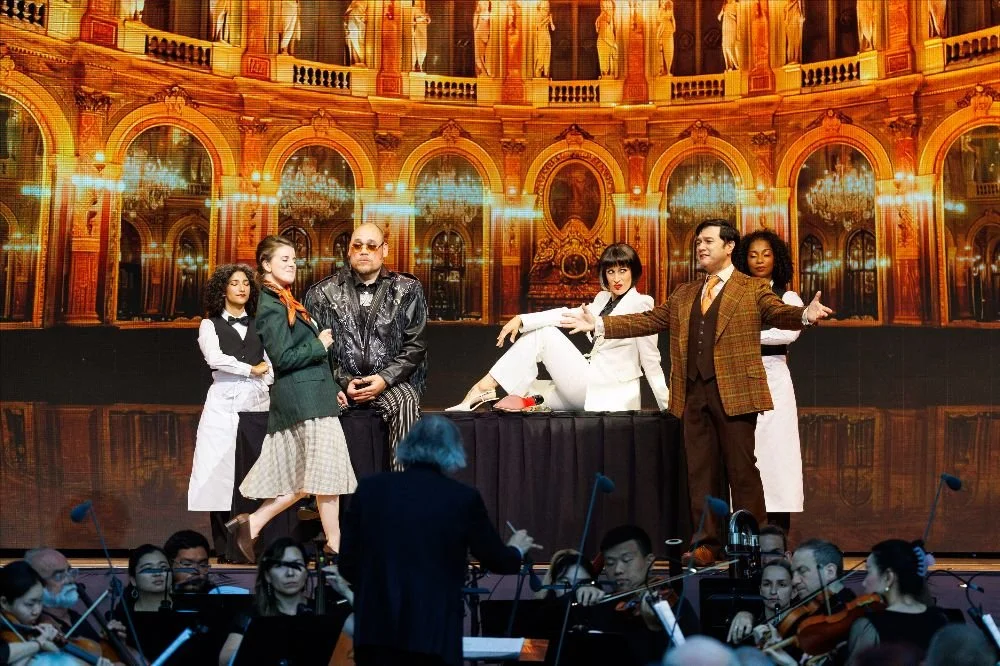
With Simone McIntosh, Brenda Rae, Quinn Kelsey, and Kent Nagano in the World Premiere of Jake Heggie and Gene Scheer’s The Judgement of Paris at Festival Napa Valley
When we began rehearsals for Jake and Gene’s new opera–a witty comedy about winemaking, winetasting, and Greek/Roman gods–I found myself face to face with those insecurities for the first time in a very long time. I could see the ways in which they would try to subvert my learning process, manifesting first as a reluctance to engage. The horrified look on my face when our director, Jean-Romain, mentioned that there would be a bit of choreography in my first scene in the opera must have been comical in and of itself. But, thinking about these horoscopes that would pop up in my social media feed each morning, I began to reassess what I was bringing to this relationship with comedy and opera. Instead of bringing a sense of adventure and the hard-won tools of the trade I have learned over my many decades doing this, I could see that I was carrying a shield with me into the rehearsal room, my eyes focused on the exit sign.
One lesson that is emblazoned on me from those early years of Rossini and Donizetti is that comedy is hard. It’s much more difficult than drama, where you can just ride the spontaneity of emotion. Comedy requires precision and a heightened sensitivity to everyone and everything around you. It requires that you take it seriously, approach it in a disciplined way, and treat it with respect and humility. All the same things that any other music demands of us. Setting down the shield forged from my insecurities, and leaning into the chamber music-like qualities of comedy over the course of the rehearsal process for Judgement, I found myself having yet another joyous and transformative experience.
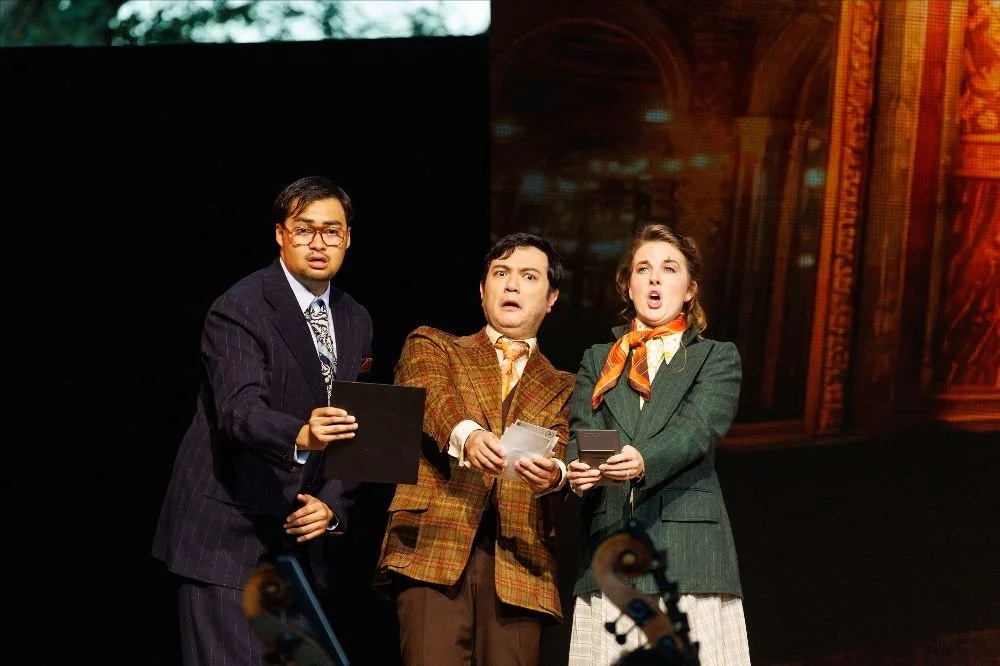
With Simone McIntosh and Ross Macatangay in the World Premiere of Jake Heggie and Gene Scheer’s The Judgement of Paris at Festival Napa Valley
Immediately following the premiere of Judgement, I flew to Tanglewood for mine and Myra’s Fellow Citizens program, which meditates on one of the most pressing human issues of our time–forced human migration–through the lens of songs by composers like Schubert, Crawford Seeger, Bartók, Dvorak, as well as the world premiere of a new song cycle by Shawn Okpebholo. Preparing in the context of our work for Judgement, I began to see the heaviness with which I had been approaching my recital work the past while, pressuring myself to be “perfect” and fighting through concerns about how people might think about my singing as I sought to find the emotional core of each piece. Through the joy I had found in my “serious” approach to our comedy in Napa, it became much easier to clearly deliver the human messages each song is meant to convey. Freed from the pressure to be “perfect”, I was able to refocus on a “simply serious” approach to preparing for this recital, and in the process came to understand that I could find a deeper level of joy in this space, too.
Looking back at this past month, it seems the stars delivered on their promise, although it was perhaps not exactly the type of relationship I expected to reassess. I am fascinated and elated by the ways in which non-resistant approaches can transform, and am reminded yet again that, while it seems counterintuitive, through discipline and rigor, we can find freedom of expression.
As always, I hope to cross paths with you somewhere soon, either in person or online. In the meantime, enjoy these final weeks of summer.
– nick
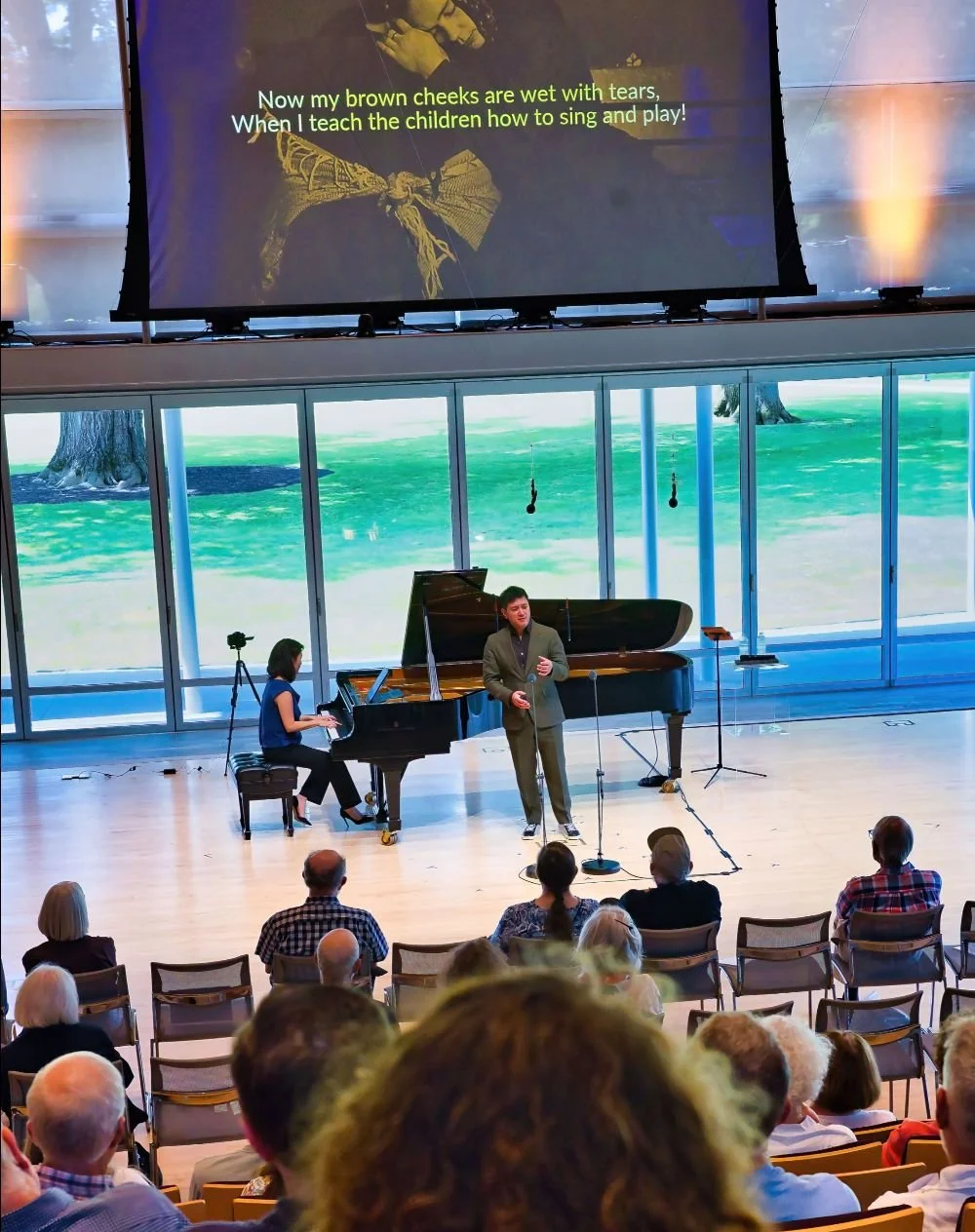
Performing Fellow Citizens with Myra Huang at Tanglewood (photo: Hilary Scott, Boston Symphony Orchestra)