High school students, anxiety about our changing climate, and the music of Lamenting Earth
NOTE: I am now publishing these essays here and also publishing them at my new Substack. If you wish to receive these in your inbox, please subscribe via the button below!
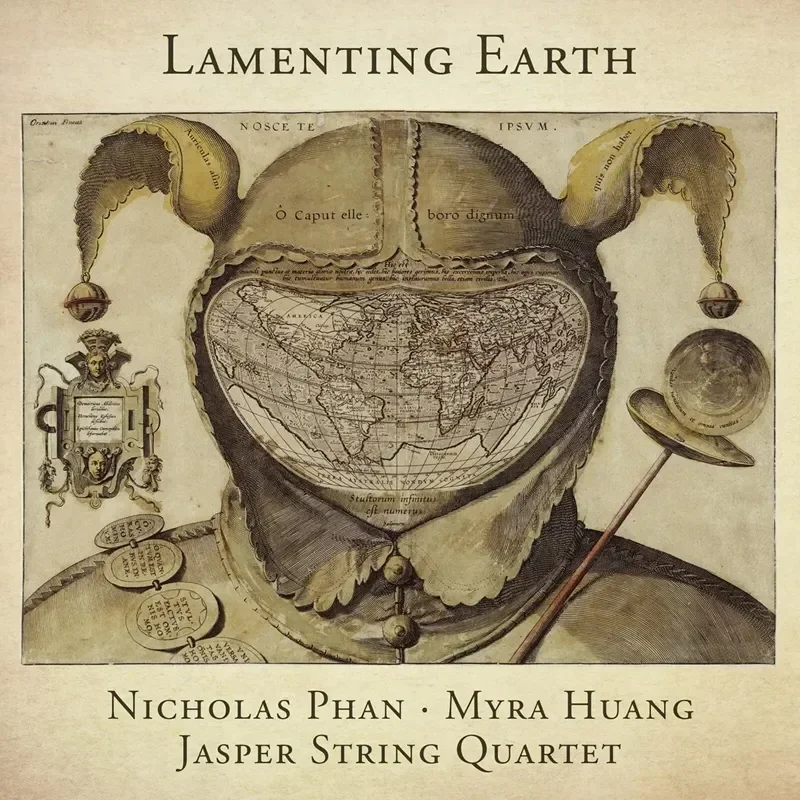
This weekend marks the release of Lamenting Earth, our latest album on Avie Records. To mark the release, I am republishing the liner note for the album below.
Throughout the history of humanity, we have ping-ponged between two ideas about our relationship with nature: that we are a part of it, and that we are separate from it. In this oscillating narrative, we have also engaged in what can feel like a multi-generational struggle with the natural world, at times believing we can subjugate and control it, and at others seeking to understand its rhythms and harmonies in order to live within its bounds and benefit from its gifts.
This album traces several moments in that evolving relationship, juxtaposing works shaped by Romanticism and Transcendentalism with contemporary responses to humanity’s environmental crisis. In the nineteenth and early twentieth centuries, nature was often understood as mysterious, sublime, and morally instructive. A place where human beings could recognize their smallness, reflect on their inner lives, and find refuge from an increasingly industrialized world. The music and poetry of that era stand in sharp contrast to our present moment, in which humanity’s confidence in its power to master the environment has revealed itself as dangerously misplaced. The fragile balance we once observed has been disrupted, with consequences that are no longer abstract or distant.
The songs of Franz Schubert, Charles Ives, and Ralph Vaughan Williams on this recording inhabit a world in which nature remains a powerful interlocutor. Schubert’s songs evoke water, stillness, and solitude as mirrors of human feeling—nature as both companion and teacher. Vaughan Williams’s On Wenlock Edge, drawing on A. E. Housman’s poetry, places the individual within vast cycles of time and landscape, where hills, wind, and earth outlast human joy and grief alike. Ives’s Housatonic at Stockbridge blurs memory, hymn, and river into a shimmering meditation on transcendence, where nature becomes a spiritual threshold rather than a backdrop.
Set alongside these works are two contemporary pieces that reflect a profound shift in perspective. Patrick Castillo’s Skyline Palimpsest emerges from the experience of displacement and return, approaching the Manhattan skyline from afar, witnessing constant erasure and rebuilding, and recognizing how places we call “home” change without regard for us. Beneath its meditation on memory and belonging lies an unsettling truth: cities like New York face an uncertain future in a warming world.
Vivian Fung’s Lamenting Earth confronts that urgency directly. Anchored by Claire Wahmanholm’s poem O and expanded through the voices of high-school students responding to climate change, the cycle foregrounds youth perspectives often left unheard. Their words transform lament into testimony, asking not only to be heard, but to be taken seriously.
Taken together, these works chart a progression: from communion with nature, to contemplation of its power, to a reckoning with our impact upon it. This album is not an argument so much as an invitation to listen closely, to notice what has changed, and to consider what kind of relationship with the natural world we hope to leave behind.
A note from Patrick Castillo:
The writing of Skyline Palimpsest took place near the end of my first year as a displaced New Yorker & newly minted Philadelphian: the tenth move of my life, this time departing the place I had lived the longest. My occasional visits back to New York—approaching the lower Manhattan skyline for several miles of the New Jersey Turnpike—have continued to feel like homecomings. Yet the razing and rebuilding never cease. Every visit feels like discovering a new city.
When leaving, and when revisiting, the sites of our lives’ experience, we confront the sobering reality that life goes on without us; that as much as we might measure how we change by the time we spend in these places, so do those places change—even places we think of as “home”—utterly indifferent to us. An especially disquieting way in which home changes: before long, New York City, like many other homes to millions of other people, will be underwater.
A note from Vivian Fung:
I composed Lamenting Earth in response to a growing sense of urgency about the state of our planet. The work began when the Jasper String Quartet invited me to collaborate on a project involving the poetry of Claire Wahmanholm, particularly her poem O, which traces the evolving vocabulary of climate change through words beginning with that single letter. I was captivated by the poem and immediately knew it needed to sit at the center of what I began to envision as a song cycle.
From there, the project expanded in a way that felt both natural and necessary. As a parent, I feel keenly the weight carried by younger generations, who often lack meaningful outlets to express their experiences and feelings about our changing climate, the legacy they will inherit from us. When Nicholas Phan joined the project, he invited us to partner with the Kaufman Center in New York City as part of his tenure as an Artist-in-Residence there, asking high-school students to respond creatively to Wahmanholm’s poem. Writing during their English classes, these students gave voice to fears, grief, and anxieties that were striking in their honesty and emotional depth. From their poetic responses, I selected three poems to complete the four-song cycle.
Thinking about my own child in the context of this work, it felt important to give young people a voice in this dialogue. Lamenting Earth is, in part, an attempt to listen.
Above all, I hope listeners will attend closely to the words. These songs are not only laments, but acts of witness: urgent, vulnerable, and deeply human.