An Offering
Bach, Sacred Spaces, Open Doors
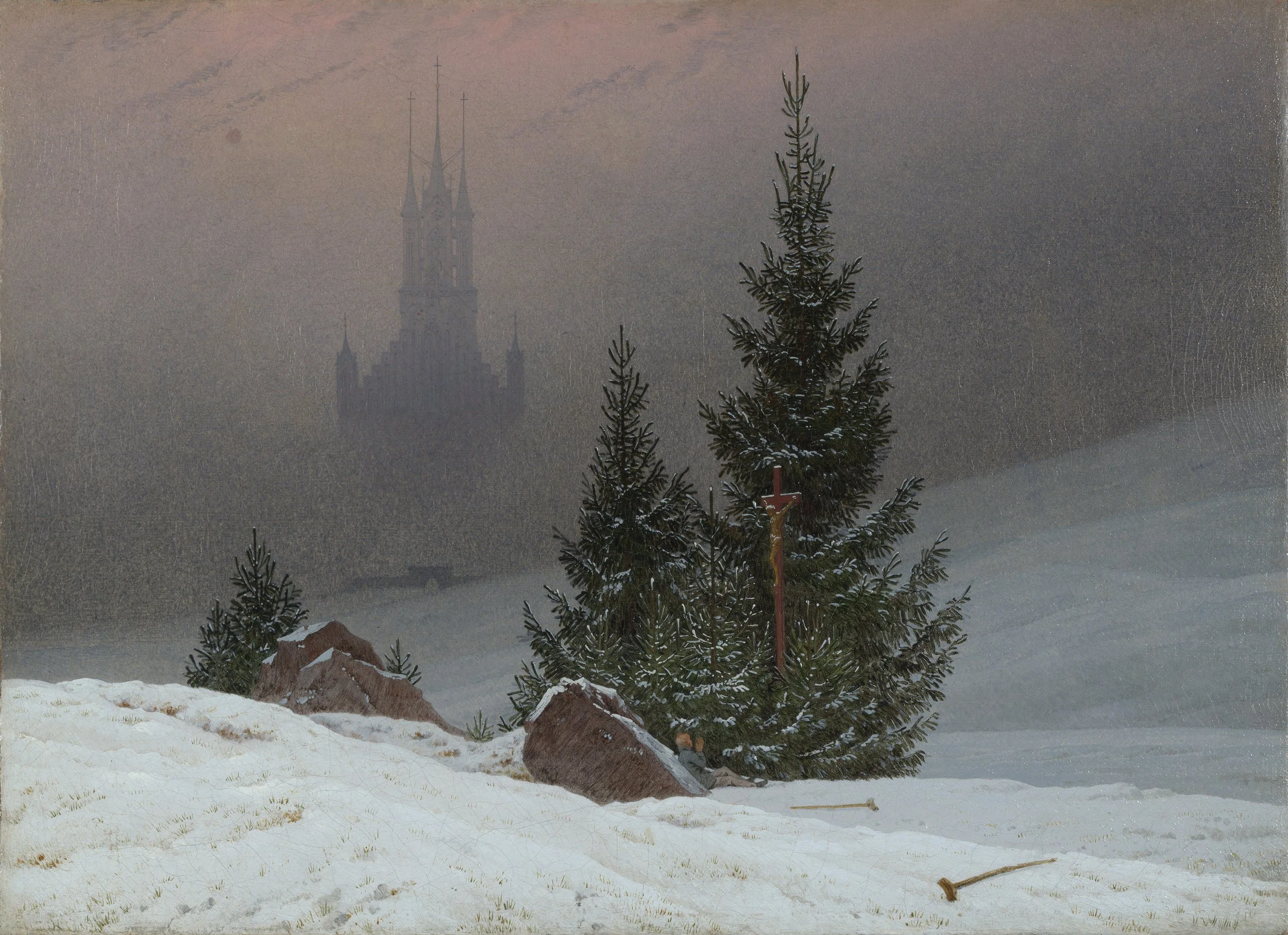
Caspar David Friedrich, Winter Landscape
I flew straight into this weekend’s historic blizzard for a performance I will give tomorrow night with the baroque ensemble Theotokos at the Cathedral of St. John the Divine, as part of Carnegie Hall's Well-Being Concert series. The program is an outgrowth of BACH 52, featuring Bach arias that have either already been part of the series or will be featured in later episodes after we film them this week. The premise of Carnegie Hall's Well-Being concerts is a noble one: to combine world-class musical performance with elements of self-care and mindfulness. The concept touches on something most musicians and music-lovers already understand: music has therapeutic qualities capable of focusing the mind, centering the heart, and feeding the soul. In this sense, the program feels very much like an offering.
It's always a different experience to take Bach's music into its natural habitat of a church, and I find that it often takes on a different life in sacred spaces. I'm sure part of this comes from my high-church upbringing in the Greek Orthodox tradition, with its formal and ritualistic liturgical practices. But in a more general sense, singing words about divine subjects in a sacred space creates a heightened sensitivity to the religious nature of these texts. At their best, houses of worship are precisely that: places devoted to meditation, prayer, and communion, all in service of bettering both ourselves and the communities in which we live. For me, the privilege of performing these works in such spaces becomes an unexpected invitation to consider how these texts relate to my own life and to humanity at large, rather than getting caught up in the rivalries between religious traditions or assuming a gulf between ancient times and now.
Something many BACH 52 guests have mentioned is the idea that Bach's music is a gift. In her episode, the Reverend Pamela Werntz of Emmanuel Church in Boston observed that gifts can be given in all sorts of ways and not fully received. Sometimes it's simply a matter of timing and context. When the right moment arrives, we remember that gift, and it resonates. Poor reception shouldn't diminish the gift itself. Dr. Lisa Wong, in her interview at Tanglewood last summer, offered a beautiful example: perhaps a Bach chorale isn't right for someone in a church on a given Sunday, but offered in a hospital during a difficult moment, it becomes exactly the right gift at exactly the right time.
There is a famous Beethoven remark about Bach's name: "Nicht Bach! Meer sollte er heißen!" — "Not a brook! An ocean should he be called!" (Bach means "brook" or "stream" in German.) Reverend Werntz touched on this when deepening her gift analogy, noting that even those who don't love the beach wouldn't argue that the ocean isn't a gift. When one considers that the oceans provide us with a large percentage of the Earth’s oxygen, regulate climate, and serve as a primary source of food for much of the world, even the most ardent beach-hater must acknowledge the ways in which they receive its gifts are simply different from the ways beach-lovers do.
With this in mind, while many of the texts on tomorrow night's program may seem exclusively Christian — more specifically Lutheran — at first glance, I hope that their deeper and less obvious layers resonate beyond the artificial boundaries they may inspire. Scratch beneath the surface, and an aria about the baptism of Jesus and the appearance of the Christian Holy Trinity is also music about the gift of being welcomed, without doubt, into something larger than ourselves. An aria about being swallowed so deep that no human hand can reach us is also a piece about the urgent truth of how much we need one another. An aria that talks about praising the name of the Lord far and wide is also about shouting from the rooftops that all is beautiful in the world. An aria describing faith as a seal of love is also a poignant reminder that the most divine thing about us is the love we hold for one another.
Tomorrow night is an offering. We hope that you will receive it as such, and take away whatever resonates with you.