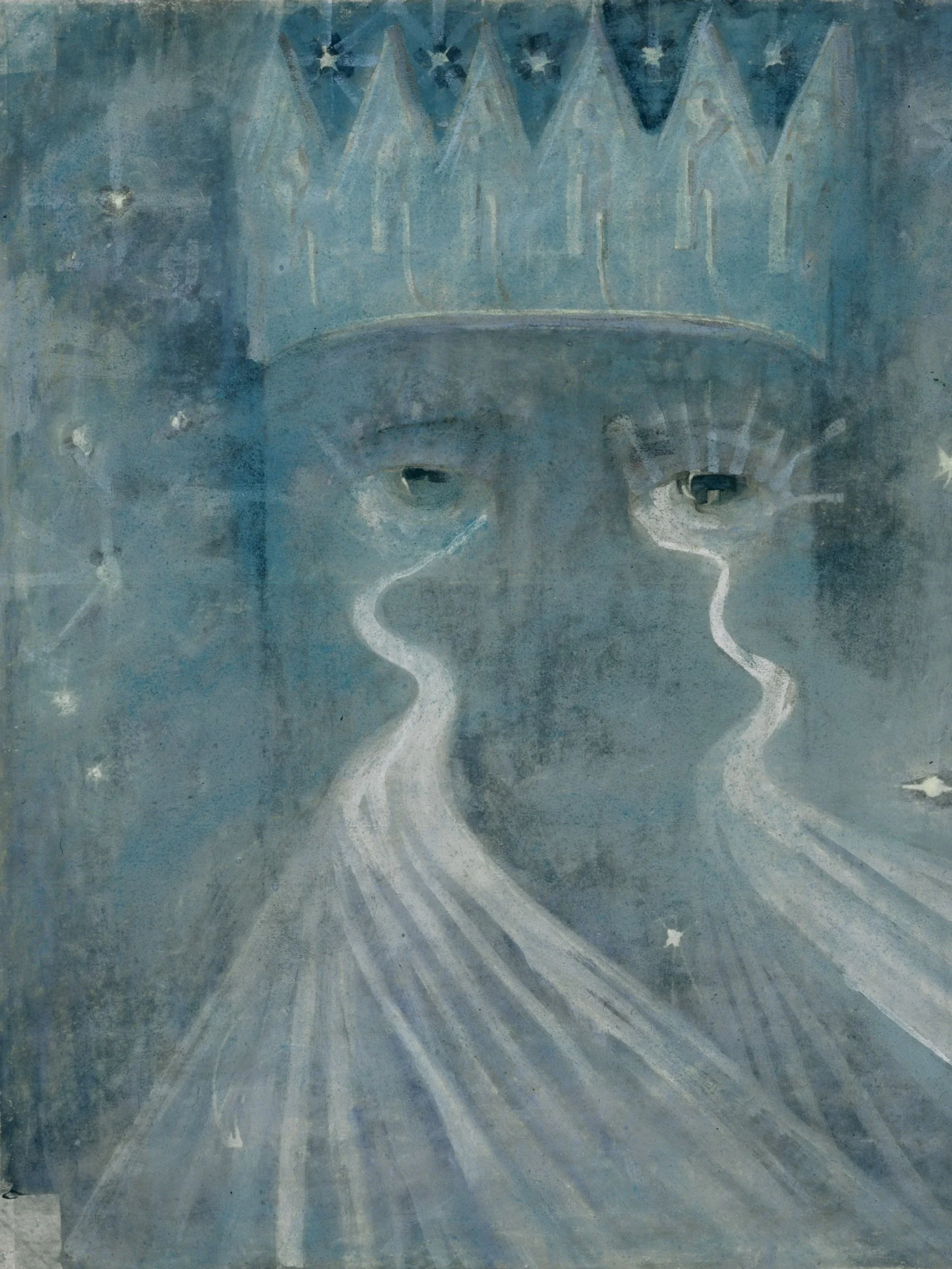
Eternity by Mikalojus Konstantinas Čiurlionis (1906)
In the year I studied at the Manhattan School of Music, my life was transformed in a rapid and overwhelming way. I had moved to New York City to begin a two-year master’s degree program at the school, but within my first six or seven months there, I had made what I consider my professional debut with the Chicago Symphony Orchestra performing Iopas in Berlioz’s Les Troyens and was offered a coveted spot in the Houston Grand Opera Studio. My time at Manhattan School was cut short by a year, and less than a year after moving to New York City, I found myself packing my belongings into a car and moving to Texas, where I would live and work for the next few years.
Beyond the extraordinary strokes of artistic and professional luck that year, so much happened in that first stint of living in New York City. Planes flew into the World Trade Center just two weeks after I moved into my apartment and started school, and Enron collapsed a few months later, just weeks before I traveled to Houston to compete for my spot in the HGO Studio. The opera housed all of the competitors at a Crowne Plaza hotel just a couple of blocks away from Enron’s headquarters, which was completely deserted. I remember bits of paper trash flying in the air around the office building’s entrance and the unlit sign on the street.
One distinct memory I have of that year is sitting next to one of my teachers, the pianist Warren Jones, during a rehearsal of Le clemenza di Tito, the Mozart opera we were all learning under his tutelage that semester. As the orchestra began to rehearse the overture, Warren and I observed one of my student colleagues tardily rushing into the rehearsal room. His arms crossed, he leaned over to me and whispered: “I never understand why people are late. All you have to do is leave five minutes earlier.” I looked at him and silently nodded, conceding he had a point.
My concession was a guilty one: I am someone who is perpetually late for things, especially whatever appointment is first in my day. I often think of this moment from my student days, frequently with a mixture of chuckling and chastisement, as I imagine Warren’s judgmental look as he peered at me over his glasses, his eyes darting back and forth between me and my student colleague frantically trying to unpack her things without causing too much of a disruption to the rehearsal already underway. Part of the reason I am always late is that I am constantly trying to pack too much into my days. I am frankly delusional about how long certain tasks and activities take and am seemingly incapable of budgeting one of the few resources that is truly finite: time.
A lot of this is my enthusiasm for all that I do. I love all of the aspects of my work and art, and I am hungry to learn and practice as much as I can. Voraciously curious, I am constantly lost down rabbit holes of factoids, news, and repertoire. Always wanting to be helpful, I am overly generous with my time to further the cause of a colleague, organization, friend, or family member. Passionate about music and performing, I often find myself baffled that I have so little time to be home, weeks and months in my calendar blocked out for musical projects around the globe.
When tragedy struck my parents a few years ago, another vivid memory comes to mind. One day early on in that ordeal, my father and I were home on a break from visiting my mother in the ICU, where she was recovering from multiple strokes that had just befallen her. Sitting at the kitchen table that afternoon, we were still so unsure of what would be possible for her recovery, if much at all. It was clear that she was severely debilitated and that if there was to be any path forward to recovery, it would be a long and arduous one, at best. It was also increasingly evident that there might not be one, and that her life would be forever altered, if she even continued to survive.
While we sat there, my father relayed that his doctors had noticed his PSA levels were elevated and that it was likely he had prostate cancer. After talking me through what the next steps were in terms of diagnosis and potential treatments, he paused and then shook his head talking about certain plane tickets, restaurant reservations, and other engagements that he would need to cancel. He seemed bewildered that any of this was happening at all.
In fairness, it was bewildering. Both he and my mother were only in their early 70s. By all accounts, they should have gone on to live another decade or two, and it’s hard not to feel like we were robbed of the time we should have had with them. Observing his bewilderment, I was struck by how unprepared he was for this moment in their life.
My father loved wine, fine dining, travel, history, classical music, science, and debate. My mother loved those things, as well as her church, Greece (the country of her ancestors), and justice. They both loved their children and absolutely adored their grandchildren. In that moment, I was struck by how fearlessly they lived their lives, not thinking of old age nor anything end-of-life in a serious way. My father was happy to drink fine wines and graze on foie gras (one of his favorite foods) to his heart’s content. Beyond accruing savings for a retirement he imagined was far in the future, he had no plans of retiring from his lab nor his research to which he had dedicated decades of his life. My mother was happy to let a conflict in her life and community burn until she was satisfied it was resolved in a manner that was uncompromisingly right by her standards and definition. She had no qualms about putting her life in America on pause in order to spend three months a year in Greece in the small town where our family came from. In that moment, I saw in sharp relief how they were both so firmly rooted in the present moment, a thing which feels so foreign to me when I think about how I have operated my life and career based on what the future holds. How much I can drink or eat in a given day is dictated by how much I will have to sing later in the evening or the next day. When thinking about how to plan financially and how much work to take on, I am keenly aware that (if all remains healthy and functioning), there is a time limit on my vocal prime. As an opera singer, our instruments housed inside our physical bodies, we are constantly navigating the reality of a physical peak and inevitable decline.
In an age in which we are constantly bombarded with new apps and AI technologies that promise to help us manage our time better and maximize our productivity, it’s difficult to not lean into the chastisement part of the mixture when I think of that school-time memory of Warren pointing out how simple it is to just be on time. That memory popped into my head a couple of years ago in Boston, as I was wandering through a bookshop on a free day between performances of Mozart’s Don Giovanni with Boston Baroque. Browsing the shelves, I couldn’t help but notice one by the author Oliver Burkeman: Four Thousand Weeks: Time Management for Mortals. Inevitably, that memory of Warren combined with the thought of the number of undone items on my To-Do and Want-To-Do lists flashed through my mind, so I compulsively picked it up. Delving into the book, I was quite surprised by its philosophical approach. Burkeman begins by outlining how theoretically, if we live to the average life expectancy (which my parents didn’t, by the way), it comes out to about 4,000 weeks to live, which really doesn’t seem to be that much time. He then points out that unless we commit suicide, we don’t know when our time in this life will be up, and we can’t control when our clock will stop. From there, he begins to suggest a practice of non-resistance to these morbid facts: if we don’t know, then let’s not worry about it and make the most of the time that we do have. During those painful and trying years with my parents’ health struggles, the ideas in that book brought me untold amounts of comfort as I did my best to embrace those concepts and put them into practice.
As we navigated the final years with my parents and the sad and boring logistics of end-of-life business, it became increasingly clear how present my parents were in their life, unprepared for this moment in many ways that other people their age I knew were not. Each time I would notice that something wasn’t in order in the way that many might have felt it should have been, I would marvel at the happy life they had led, thinking of the copious happy memories they shared with both each other, as well as my brother and me. They really just didn’t worry about it and enjoyed their life to the fullest in the moments that they did have.
I am still late to things, and that is probably not okay for my colleagues and my loved ones, who are either exceedingly patient with me or find it irritating. Just a little over a week ago, I was rushing to a session to coach the young artists at the San Francisco Opera in a desperate attempt to at least walk through the rehearsal room door on time. I was running behind because my own practice session for an upcoming concert in Philadelphia had run over, as I was fascinated in trying to understand the strange and creative decisions composer Louise Talma had made in her setting of Wallace Stevens’ Thirteen Ways of Looking at a Blackbird. As I hustled from the MUNI station to the opera house, the crosswalk signal started to change at my final street crossing, so I made the decision to break into a sprint so I wouldn’t miss the light. I tripped spectacularly onto the sidewalk, badly bruising my knee and scraping up my arms and hands. It must have been a spectacular sight, as two fellow pedestrians rushed over in a panic, asking if I was okay and if anyone needed to dial 911. Determined to be as close to on-time as possible, I brushed them away and thanked them for their concern, hobbling as quickly as I could to the opera house. I didn’t even notice how cut up my hands were until ten minutes into the young artists’ coaching.
Again, I thought of Warren’s admonishment: “All you have to do is leave five minutes earlier!” Perhaps one day I will learn, and it will become easy to be on time. And then again, thinking of the lessons I’ve gleaned from my parents’ example these past few years: maybe I won’t.
John Dowland: Time Stands Still
"Time stands still with gazing on her face, / Stand still and gaze, for minutes, hours and years to her give place. / All other things shall change but she remains the same, / Till heavens changed have their course and Time hath lost his name."
Dowland's meditation on presence, devotion, and the suspension of time—a truly magical thing we all wish for when it comes to those we love most—came to mind as I was writing these musings on being perpetually late, my parents' example, and what it means to truly inhabit time.
I hope you enjoy this performance filmed for San Francisco Performances during the pandemic, when it truly felt that time was standing still, with composer Jake Heggie joining me at the piano.